70 cc kit on a 50 cc two-stroke: does your pipe still match?
Tutorial 6 · about 15 minutes plus two sweeps (three if you don't have tutorial 3's project)
Fit a 70 cc kit to a 50 cc moped and keep the pipe, and the forums split: “the stock pipe is fine”, “it'll be choked”, “the kit makes torque but no revs”. Simson, Puch, Minarelli and Piaggio threads all ask some version of it.
A kit changes the bore, usually the ports and often the head. It leaves the crank, the crankcase, the carb and the pipe where they were. The question is whether a pipe built around 50 cc still does its job on 70.
This guide answers it in WaveDyno on one engine. You take tutorial 3's 50 cc engine, change only the bore to 70 cc and sweep it. Then you open the ports to the bigger bore, the way a kit cylinder would, and sweep again. Each run changes one thing, so you can see what each change did.
What the page can't answer:
- Your kit. The example is a generic piston-port single, not a model of any moped or of any kit. The Minarelli AM6 and the Piaggio 50s (NRG, Typhoon, Zip) take their intake through a reed valve into the crankcase, so their intake side works differently. The pipe question is the same kind of question.
- The carb. WaveDyno has no carburettor model: no jetting, no mixture by rpm. The intake here keeps the 50 cc's 21 mm, and the page can't tell you whether you need a bigger one.
Everything here runs on WaveDyno's free plan with daily run limits. Each sweep has 19 points and counts against the daily limit; the Run dyno button shows the estimate before you start (21.4 to 22.2 units for each sweep here). If you have tutorial 3's project, you need two sweeps; from scratch, three. A finished sweep is charged what it actually used, up to its estimate. Depending on what you've already run today and what each sweep is charged, you may not get through them all in one UTC day, even without the optional finer sweep in step 2. The app refuses a run whose estimate doesn't fit in what's left of the day, and the limit resets at midnight UTC. Your runs stay in the project, so you can pick up where you stopped.
The engine
Start from the 50 cc engine in Tune a 50 cc moped pipe, tutorial 3.
- If you have tutorial 3's project, use it. Restore the
baselinerun's inputs (Compare → Restore settings from baseline) so the transfer, chamber and stinger changes from that guide are gone. Its baseline sweep is your 50 cc result; you don't need to run it again. - If you don't, build it as tutorial 3 steps 1 and 2 describe: the setup wizard with bore 38, stroke 44, the ports, the intake carb and target 7900, then the intake port edit. Set the sweep to 5000 → 9500, step 250, Quality Standard (tutorial 3 step 4), run it and name it
baseline.
If your baseline comes back at once, marked cached, the app has found an identical run and reused its result. The numbers are the same.
Check what you start from. Build → Engine reads 49.9 cc, 38×44 mm, CR 15, Case compression 1.4. Build → Ducts reads 1255.4 mm total, tuned ≈ 7900 rpm. Keep the sweep the same for every run in this guide: Compare only shows a delta where both runs have the same rpm.
In our baseline all 19 points converged. Its best sampled point is 6.88 kW (9.35 PS, 9.22 hp) at 7,250 rpm, and it falls off the pipe by 43.5 % between 7,250 and 7,500. Tutorial 3 step 5 reads the curve in detail.
1. Fit the kit: bore 38 → 45 mm
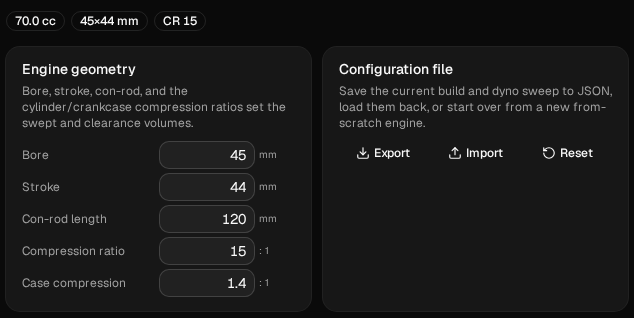
Open Build → Engine and change Bore from 38.00 to 45.00. Nothing else.
The badges now read 70.0 cc and 45×44 mm. That's 40 % more swept volume.
What the app keeps, and what that means:
- Compression ratio 15 stays 15. It's a ratio, so the clearance volume grows with the bore, from 3.56 to 5.00 cc. That's a head made for the kit. With the 50 cc head's 3.56 cc on a 45 mm bore, the geometric ratio would be 20.6:1.
- Case compression 1.4 stays 1.4. That's a ratio too, so the model's crankcase grows with the bore, from 125 to 175 cc at bottom dead centre. A real kit on a stock engine keeps the stock crankcase, which would make the ratio about 1.56. This guide keeps 1.4 in every run, so each run changes one thing; it doesn't test the higher case ratio.
- The port widths stay as you typed them, in mm across the bore. On the bigger bore the same window is a smaller share of it: on Build → Ports, main ex width/bore drops from 67 % to 57 %.
- One detail of that: WaveDyno stores port widths as straight lines across the bore (chords) and simulates the curved window on the cylinder wall. On a 45 mm bore the same chord is a slightly shorter arc, so this run is slightly narrower in developed exhaust and intake width, −3.0 % and −2.8 %. You can see it in the exhaust area badge on Build → Ports (505 → 490 mm²) and the intake card's Flow area line (492 → 478 mm²).
- The pipe, the ignition curve and the port timing don't change. Build → Ducts still reads 1255.4 mm total and tuned ≈ 7900 rpm: the badge works from the pipe's lengths and the port timing, and the bore is in neither.
So this run is the kit's extra capacity with a kit head, on the 50 cc's ports, pipe and carb.
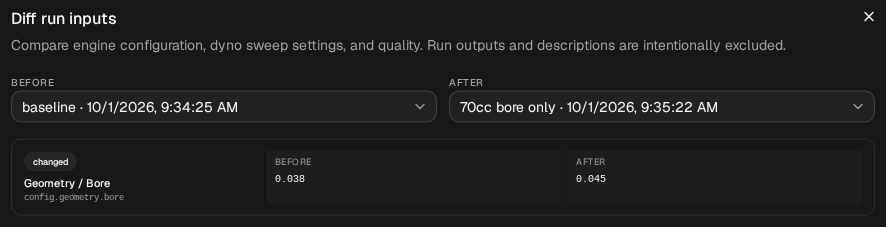
Run it and name it 70cc bore only. Open Compare → Diff inputs, pick baseline as Before and 70cc bore only as After: it should list one change, Geometry / Bore, 0.038 → 0.045 (in metres). In our run all 19 points converged.
2. Read the 70 cc against the 50 cc
In Compare, show baseline and 70cc bore only, and click baseline on baseline.
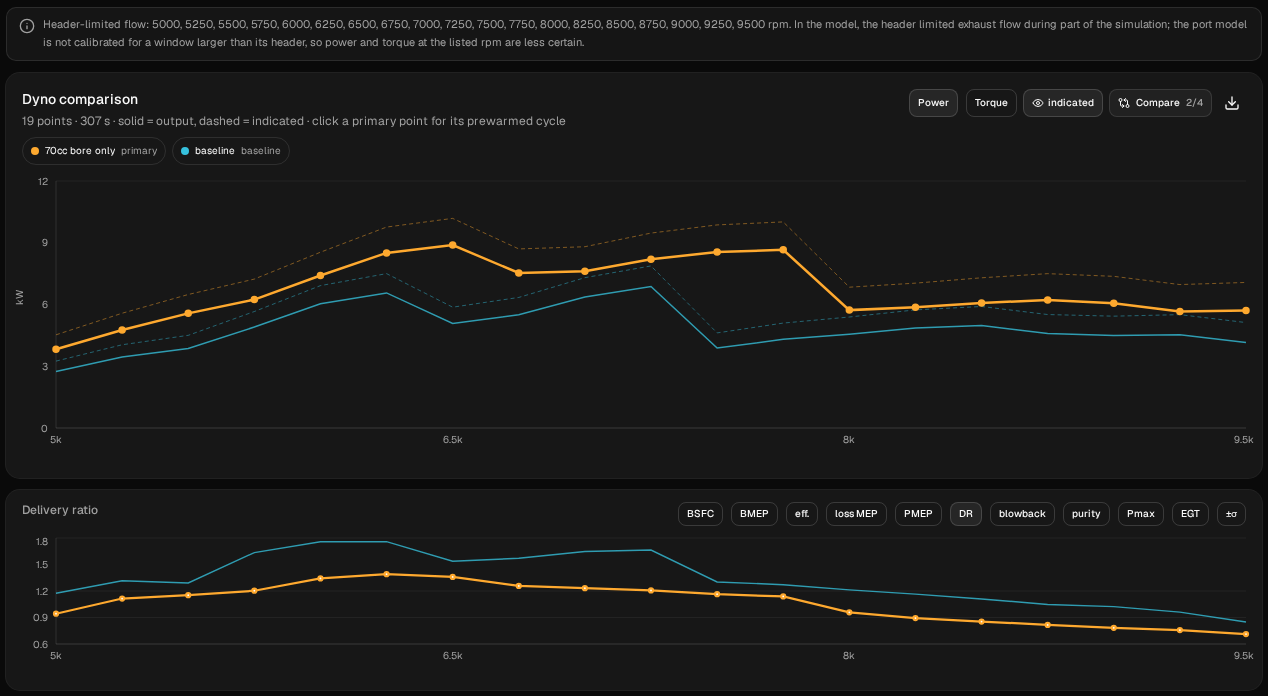
The grey “Header-limited flow” notice shows on every point of this engine: “In the model, the header limited exhaust flow during part of the simulation; the port model is not calibrated for a window larger than its header, so power and torque at the listed rpm are less certain.”
| rpm | 50 cc kW | 70 cc bore only kW | change |
|---|---|---|---|
| 5,000 | 2.75 | 3.83 | +39.2 % |
| 5,250 | 3.45 | 4.76 | +37.8 % |
| 5,500 | 3.86 | 5.57 | +44.2 % |
| 5,750 | 4.90 | 6.24 | +27.3 % |
| 6,000 | 6.04 | 7.41 | +22.7 % |
| 6,250 | 6.56 | 8.51 | +29.6 % |
| 6,500 | 5.08 | 8.89 | +75.1 % |
| 6,750 | 5.50 | 7.53 | +37.0 % |
| 7,000 | 6.37 | 7.61 | +19.6 % |
| 7,250 | 6.88 | 8.20 | +19.2 % |
| 7,500 | 3.89 | 8.54 | +119.9 % |
| 7,750 | 4.31 | 8.66 | +101.0 % |
| 8,000 | 4.56 | 5.73 | +25.6 % |
| 8,250 | 4.86 | 5.87 | +20.9 % |
| 8,500 | 4.98 | 6.08 | +22.0 % |
| 8,750 | 4.60 | 6.22 | +35.4 % |
| 9,000 | 4.50 | 6.06 | +34.9 % |
| 9,250 | 4.54 | 5.66 | +24.7 % |
| 9,500 | 4.15 | 5.71 | +37.6 % |
Italics: 6,500 is the 50 cc's dip (tutorial 3, step 5). Measured against the dip's 5.08 kW, the +75.1 % overstates what the bore adds, so it isn't a figure to use. At 7,500 and 7,750 the 50 cc has already fallen off the pipe and the 70 cc hasn't; that comparison is the next section.
The 70 cc makes more power at every point we can use. How much more depends on where:
- Low down, the most: +37.8 to +44.2 % from 5,000 to 5,500 rpm, about what the extra 40 % capacity would suggest.
- At the top of the 50 cc's band, the least: +19.2 % at 7,250.
- Above the band, from 8,250 to 9,500, where both are off the pipe: +20.9 to +37.5 %.
Set the second chart to DR. Delivery ratio is the fresh charge per cycle compared with what the swept volume holds, so a bigger cylinder lowers it even if more charge comes in. Here it's lower at all 19 points. Multiply it by the swept volume and you get the charge itself: at 5,000 rpm the 70 cc takes in 12 % more than the 50 cc; at 7,250 it takes in about the same (84.4 against 83.0 cc of air at ambient density). It keeps more of it: 55 % of the fresh charge it takes in stays in the cylinder, against 47 % for the 50 cc. So it traps about 19 % more fresh charge (55.8 against 46.9 mg).
That's why the gain is smallest at the top of the band. With the 50 cc's ports, pipe and carb, the 70 cc cylinder gets hardly more fresh charge through at 7,250 rpm than the 50 cc does. The extra capacity shows up lower down.
Where it comes off the pipe
The 50 cc falls off the pipe between 7,250 and 7,500 rpm: −43.5 % in one step. The 70 cc doesn't. It's still at 8.66 kW at 7,750, and by 8,000 it's down to 5.73 kW, 5.87 at 8,250.
A jump like the one at 7,500 and 7,750 (+119.9 and +101.0 %, where 7,250 moves +19.2 % and 8,250 +20.9 %), right at the edge of a drop, needs checking before you use it. So we ran a finer sweep of the same build: 7000 → 9250, step 125, named 70cc bore only fine. You don't need to repeat it. If you do, it's one more sweep (19.2 units estimated) on top of the two or three above, and it may not fit in the same day either.
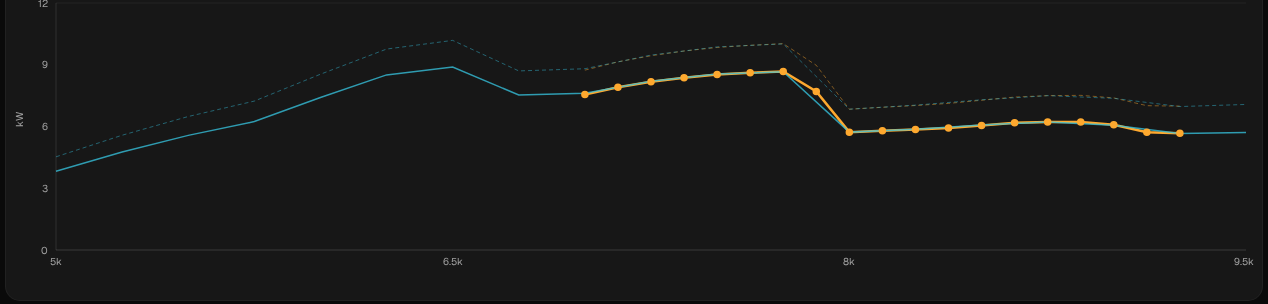
- The ten shared points agree within 0.06 kW (0.9 %), 7,750 included (8.66 and 8.67 kW). So 7,750 is a result.
- The finer sweep climbs steadily to 7,750 rpm, 8.67 kW (11.79 PS), then falls 34.0 % to 5.72 kW at 8,000, by way of 7.73 kW at 7,875. 8,000 converged in this sweep too.
So on this model, with the same pipe, the 70 cc comes off the pipe between 7,875 and 8,000 rpm, against 7,250–7,500 for the 50 cc. It holds on longer, not less.
A likely reason, which this guide doesn't test: the 70 cc's exhaust is hotter at the top of the band, 52 to 65 °C hotter from 7,000 to 7,250 rpm (433 against 368 °C at 7,250). Pressure waves travel faster in hotter gas, so they get back to the port sooner, and the pipe works up to a slightly higher rpm. How an expansion chamber works shows that timing in the wave diagram.
Where's the peak? The 70 cc curve has two humps of nearly the same height: 8.89 kW (12.08 PS) at 6,500 and 8.67 kW (11.79 PS) at 7,750, 2.4 % apart. The full sweep's highest sample is 8.89 kW at 6,500. The finer sweep starts at 7,000, so it misses that hump; its highest sample is 8.67 kW at 7,750. These runs do not locate the continuous maximum.
3. Open the ports to the kit's bore
If you ran the finer sweep, put the sweep back first: restore 70cc bore only (Compare → Restore settings from 70cc bore only), or set Run → Setup back to From 5000, To 9500, Step 250, and keep Quality Standard. Otherwise the kit run inherits the finer grid: its table won't line up with the one in step 4, and Diff inputs below lists three more entries.
A kit cylinder isn't a stock cylinder bored out: its ports are cut for the bigger bore. Kits differ, so here's one assumption, stated: the kit's ports are the 50 cc's, scaled to the bore, with the same timing. Every window is 45/38 as wide, so it takes the same share of the bore as on the 50 cc. That isn't any kit's specification.
On Build → Ports (tutorial 4 shows the tab), change only the window widths, in mm:
| Window | 50 cc (as shown) | Kit |
|---|---|---|
| Exhaust, main window Width | 25.5 | 30.2 |
| Transfer A | 13.42 | 15.9 |
| Transfer B | 11.98 | 14.2 |
| Transfer C (boost) | 7.1901 | 8.5 |
| Intake port, Window width | 24.7 | 29.3 |
Transfer C may show more decimals than the others (7.1901); just type 8.5. Don't touch any opening angle, height or other field.
Check the result. The timing ring still reads Ex 170° · Tr 120° and intake 145°. Main ex width/bore is back to 67 %. The exhaust area badge reads 598 mm² and the intake Flow area 584 mm² · equivalent Ø 27.3 mm. The transfer total on the Port timing card reads chord Σ 39 mm: that's one side (A + B + C), rounded to whole mm, not the five-window total you typed into the wizard.
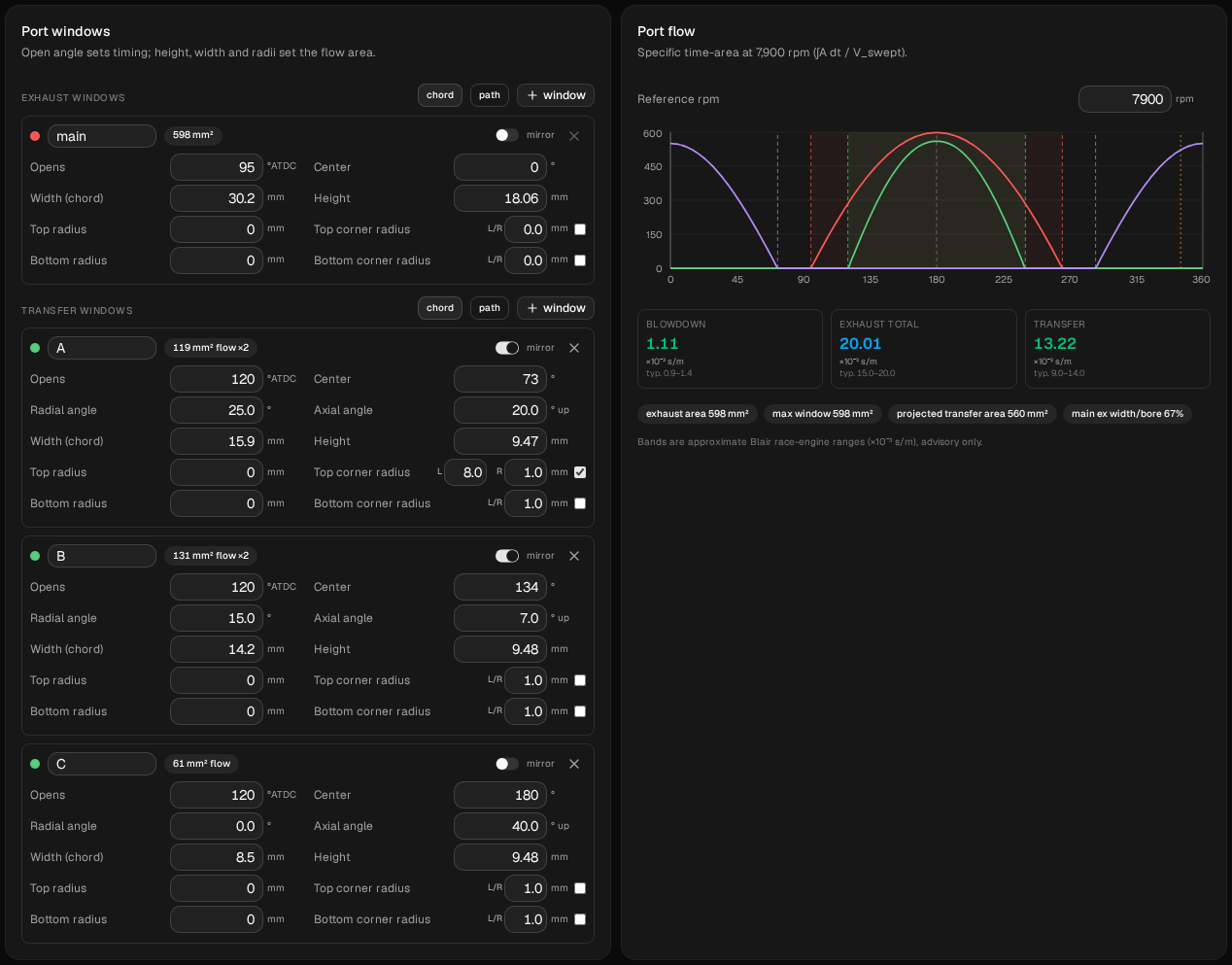
Run it and name it 70cc kit ports. Diff inputs against 70cc bore only lists seven entries: the five widths, plus the exhaust and transfer group totals that follow them.
4. Read the kit's ports against the bore alone
In Compare, show 70cc bore only and 70cc kit ports, with the baseline on 70cc bore only.
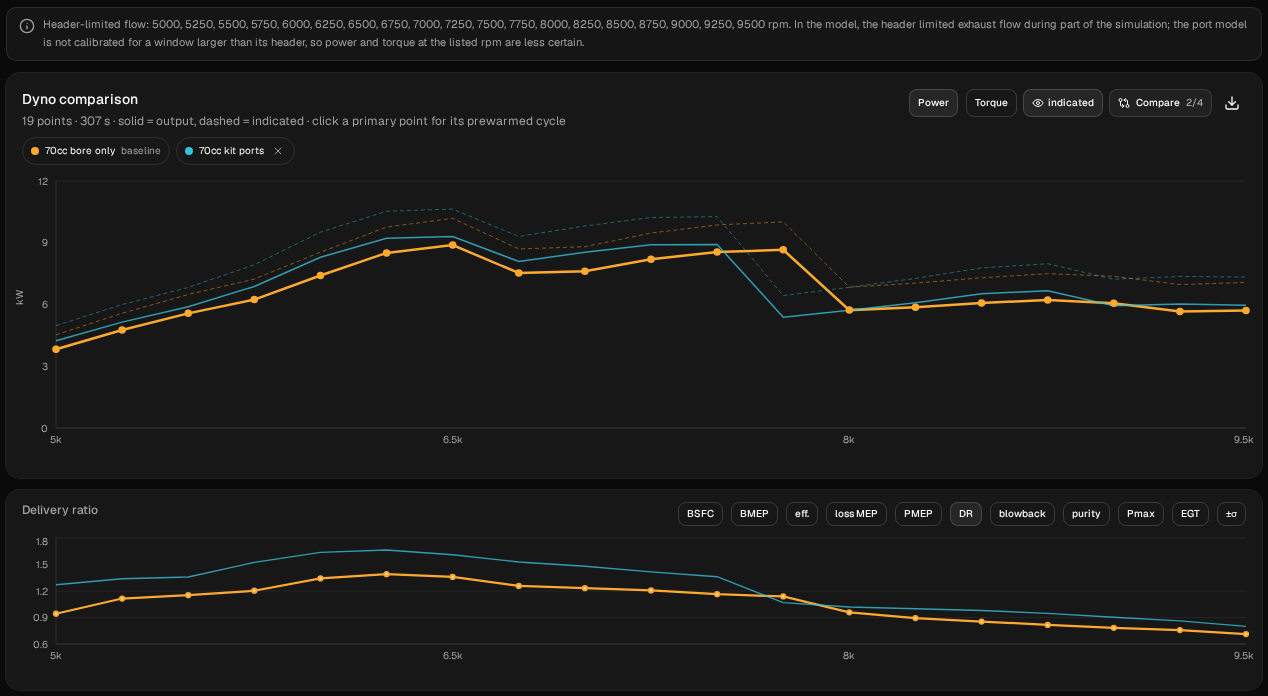
| rpm | 70 cc bore only kW | 70 cc kit ports kW | change |
|---|---|---|---|
| 5,000 | 3.83 | 4.24 | +10.8 % |
| 5,250 | 4.76 | 5.14 | +8.1 % |
| 5,500 | 5.57 | 5.89 | +5.7 % |
| 5,750 | 6.24 | 6.87 | +10.2 % |
| 6,000 | 7.41 | 8.30 | +12.0 % |
| 6,250 | 8.51 | 9.22 | +8.4 % |
| 6,500 | 8.89 | 9.31 | +4.7 % |
| 6,750 | 7.53 | 8.09 | +7.4 % |
| 7,000 | 7.61 | 8.54 | +12.2 % |
| 7,250 | 8.20 | 8.90 | +8.6 % |
| 7,500 | 8.54 | 8.92 | +4.4 % |
| 7,750 | 8.66 | 5.38 | −37.9 % |
| 8,000 | 5.73 | 5.72 | −0.1 % |
| 8,250 | 5.87 | 6.09 | +3.7 % |
| 8,500 | 6.08 | 6.52 | +7.3 % |
| 8,750 | 6.22 | 6.67 | +7.3 % |
| 9,000 | 6.06 | 5.94 | −2.0 % |
| 9,250 | 5.66 | 6.03 | +6.6 % |
| 9,500 | 5.71 | 5.96 | +4.3 % |
All 19 kit points converged.
- On the pipe, the bigger ports add 4.4 to 12.2 % from 5,000 to 7,500 rpm, with the most at 6,000 and 7,000. At 7,250 the kit delivers 19 % more fresh charge than the 50 cc, where the bore-only run delivered about the same.
- Above the band, from 8,250 to 9,500, they add up to 7.3 %, except at 9,000, where the kit is 2.0 % behind.
- But the kit comes off the pipe one step after the 50 cc, between 7,500 and 7,750 rpm: −39.7 %, against the 50 cc's −43.5 % between 7,250 and 7,500. At 7,750 it's 37.9 % below the bore-only run, which is still on the pipe there.
Its exhaust temperature at the top of the 50 cc's band is close to the 50 cc's, too: 374 °C at 7,250, against 368 for the 50 cc and 433 for the bore-only run. That fits the reason in step 2, but again, this guide doesn't test it.
The kit's best sampled point is 9.31 kW (12.65 PS, 12.48 hp) at 6,500 rpm, and its upper hump is 4.1 % lower, 8.92 kW at 7,500. Against the 50 cc, it's ahead at all 19 points: +29.4 to +129.6 % from 5,000 to 7,500 (leaving out the 50 cc's 6,500 dip; the +129.6 % is at 7,500, where the 50 cc is off the pipe), and +25.4 to +45.2 % from 8,250 to 9,500.
5. And the pipe?
The forum answer to “does it match?” is often “get a 70 cc pipe”. What would that be?
WaveDyno's setup wizard sizes a pipe from two things: its lengths from the target rpm and the port timing, and its diameters from the exhaust port's area. Displacement isn't an input. So we asked the wizard for the pipe it would build for each 70 cc version, with target 7900 as before, without running either:
| Section (L mm / ⌀in / ⌀out) | 50 cc (your pipe) | 70 cc, 50 cc ports | 70 cc, kit ports |
|---|---|---|---|
| header | 338.6 / 25.0 / 29.0 | 338.6 / 24.0 / 29.0 | 338.6 / 27.0 / 32.0 |
| diffuser | 436.2 / 29.0 / 75.0 | 436.2 / 29.0 / 73.0 | 436.2 / 32.0 / 81.0 |
| belly | 93.2 / 75.0 / 75.0 | 93.2 / 73.0 / 73.0 | 93.2 / 81.0 / 81.0 |
| baffle | 313.5 / 75.0 / 14.0 | 313.5 / 73.0 / 14.0 | 313.5 / 81.0 / 16.0 |
| stinger | 73.9 / 19.0 | 73.9 / 18.0 | 73.9 / 20.0 |
| total / badge | 1255.4 · tuned ≈ 7900 | 1255.4 · tuned ≈ 7900 | 1255.4 · tuned ≈ 7900 |
The lengths are identical. With the same port timing, a “70 cc pipe” for the same target rpm is the same length. The diameters follow the exhaust port, not the capacity. With the 50 cc's ports on the 45 mm bore, the exhaust area is slightly smaller (490 against 505 mm², step 1), and so are several diameters: header inlet 25 → 24, belly 75 → 73, stinger 19 → 18 mm. Only with the kit's ports (598 mm²) is the pipe wider. We didn't sweep either pipe, so this guide can't tell you what the different diameters do.
If you want your band somewhere else, that's a length change, the same one as for a 50 cc: tutorial 3, step 7, lengthens the chamber with the tuned ≈ badge and shows what it costs. A kit with different port timing would get different lengths from the wizard; that isn't tested here.
What to take from it
On this model, with this engine and the same pipe:
- The bore alone added power at every usable point, most low down (+37.8 to +44.2 % at 5,000–5,500 rpm) and least at the top of the 50 cc's band (+19.2 % at 7,250). At 7,250 the bigger cylinder got hardly more fresh charge through than the 50 cc.
- The pipe didn't stop working. The bore-only 70 cc came off the pipe a little later than the 50 cc (between 7,875 and 8,125 rpm, against 7,500–7,750), and its exhaust ran hotter there.
- The kit's bigger ports added another 4.4 to 12.2 % on the pipe, and brought the drop back down, to one step after the 50 cc's.
- “No revs” didn't show up as a lower drop-off in either 70 cc run. What changed is where the gain is: more low down than at the top. Where each curve's highest sampled point lands depends on two humps 2.4 % apart, and these runs do not locate the continuous maximum.
- A pipe built for the 70 cc by the wizard would have the same lengths. Its diameters follow the exhaust port, not the capacity: wider with the kit's ports, slightly narrower with the 50 cc's. The lengths set the band; to move it, change them.
That's one engine and one kit assumption. To try yours:
- Start from your own engine (the setup wizard, tutorial 1), sweep it, then change only the bore.
- Then the ports, as your kit has them. If your kit changes the timing too, that's a separate run (tutorial 4 moves a port).
- Compare at the same rpm (Compare two pipes), and check any single point that jumps with a finer sweep before you use it.
These are simulated estimates from a 1D gas-dynamics model of a generic engine, not measurements, and not your engine or your kit. The model isn't calibrated against a dyno, and even the differences between the runs hold only for this model. It shows falling off the pipe as a sharp step, sharper than a real dyno would. Nothing here says how a kit will ride. Use WaveDyno to compare designs and to see what changes where, and confirm on a real dyno before building. See the Terms of Service, section 4.