What does a power valve actually do? Closed vs open on a 125 two-stroke, and what a stuck valve costs
WaveDyno tutorial 13, about 15 minutes plus three sweeps, and two short ones if you want them.
A power valve changes the height of the exhaust port while the engine runs. It's closed at low rpm, so the port is lower and opens later, and it's open at high rpm, so the port is full height. That much every explanation agrees on. What none of the ones that come up for the question shows is the power curve at each end: where closing the port helps, where it hurts, and by how much. This guide makes both ends of the valve on a simulated 125 and sweeps them, so you can see the two curves and rerun every step.
The short answer, in this model: with the exhaust roof 2 mm lower, as a closed valve would leave it, the engine made 1.63 kW (8.9 %) more at 10,000 rpm and was ahead up to 11,250. From 11,500 up it was behind, by 2.93 kW (11.1 %) at 12,250, and it fell off the pipe between 12,250 and 12,500 rpm, where the open port holds on to 13,500. So a valve stuck open costs the bottom of this sweep, and one stuck closed costs the top. A valve 1 mm short of closed sits in between at both ends.
What the page can't answer:
- What your valve does. The app's engine templates have no power valve. What this guide changes is the one thing a closed blade does to the port's timing: it lowers the roof. The 2 mm is illustrative, standing for a closed valve's later timing and smaller port (more in section 2), not the travel of any real valve.
- Valves that change the pipe. Some systems also open or close a chamber on the exhaust side, which changes the pipe's volume rather than the port's timing. The model has nothing like that, so this guide covers only the timing half of what some valves do.
- Whether your valve is stuck, and what to do about it. The example is the app's 125 moto-X archetype, the engine of tutorials 1, 4, 9, 10 and 11. It isn't a YZ125, a KTM 125 or anyone's actual bike, and the model isn't calibrated against a dyno. "What a stuck valve costs" is answered here as the difference between the model's two ends, not as a diagnosis, and the page gives no advice on cleaning, adjusting or modifying a valve.
Everything here runs on WaveDyno's free plan with daily run limits. Each full sweep has 19 points; the Run dyno button showed 16.6 units for each one, and 7.9 for the ten-point cold starts in section 5. A finished sweep is charged what it actually used, up to its estimate. Depending on what you've already run today and what each sweep is charged, you may not get through them all in one UTC day. The app refuses a run whose estimate doesn't fit in what's left of the day, and the limit resets at midnight UTC. Your runs stay in the project, so you can pick up where you stopped.
What a power valve is for
The exhaust port's height sets its timing: the higher the roof, the sooner the falling piston uncovers it. Steve Anderson put the trade-off plainly in Cycle World in April 1986. For expansion efficiency the exhaust "should open late"; for cylinder filling "it should open early"; and "the optimum exhaust-port timing will depend on engine speed." So "a simple two-stroke can't have ports that are best for both low and high speeds." Power valves, in his words, "allow the roof of the exhaust port to be raised or lowered."
Yamaha's 1981 SAE paper on YPVS (Hata and Iio, SAE 810922) opens with the same point, that "the exhaust port timing has a great effect on engine performance characteristics". Its abstract describes a valve in the exhaust passage that controls port timing according to engine speed, and tests of delivery ratio and trapping efficiency to explain the gain. Some designs go further: the Wikipedia article on power valve systems describes Honda's ATAC as "increasing or decreasing the volume of the exhaust system", and Kawasaki's KIPS as using port height, a secondary port and "a resonant chamber". That second kind is the part this model leaves out.
None of these sources has a pair of curves you can rerun. This guide sets its results beside them; it doesn't claim to confirm them.
The engine
Create a new project with the setup wizard (the + button at the top, as in tutorial 1), pick 125 moto-X / enduro, keep every answer at its default and create it. On Run → Setup, set the sweep to 10,000 to 14,500 rpm in 250 rpm steps, quality Standard: the sweep of Raise the exhaust port. Keep it the same for every full run here, so every point in Compare has a partner.
1. Valve open: the engine as it is
The template's port is the open valve: nothing blocks the roof. Run the sweep, open Compare and name the run baseline.
This is the baseline of Raise the exhaust port, and that guide walks through it: 18.33 kW at 10,000 rpm, a highest sampled point of 27.13 kW (36.4 hp) at 13,000, then off the pipe between 13,500 and 13,750. It also shows how to read Build → Ports, and why Ports takes degrees rather than millimetres. Read its section 3 if you haven't. The rest of this guide is that edit in reverse.
On Build → Ports, note three things before you change anything:
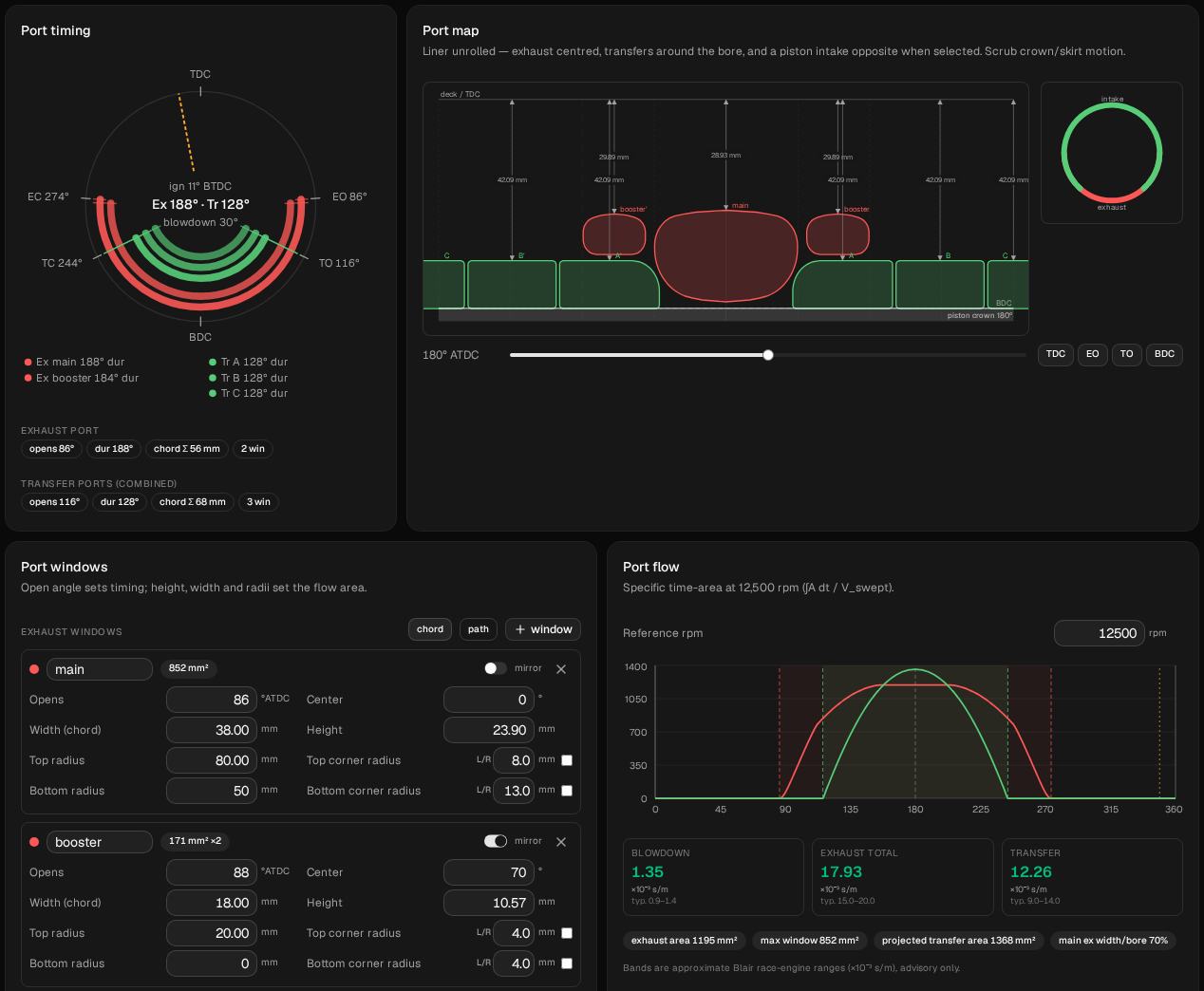
- Port timing: the ring reads Ex 188° · Tr 128°, with blowdown 30°.
- Port windows:
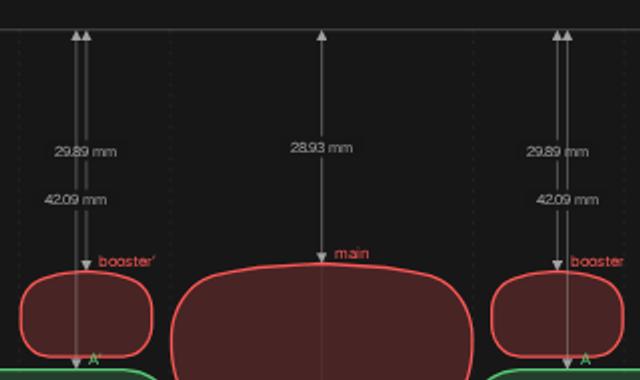
mainOpens 86, Height 23.90 mm;booster(a mirrored pair) Opens 88, Height 10.57. Each card also shows the window's area: 852 mm² and 171 mm² ×2. - Port flow: Blowdown 1.35 and Exhaust total 17.93 (×10⁻³ s/m), both green, and an exhaust area chip of 1195 mm².
2. Close the valve: both roofs 2 mm lower
A closed valve sits in the top of the port, so the roof the piston uncovers is lower, and it uncovers it later. To model that, lower both exhaust roofs, the main and the boosters, by the same 2 mm.
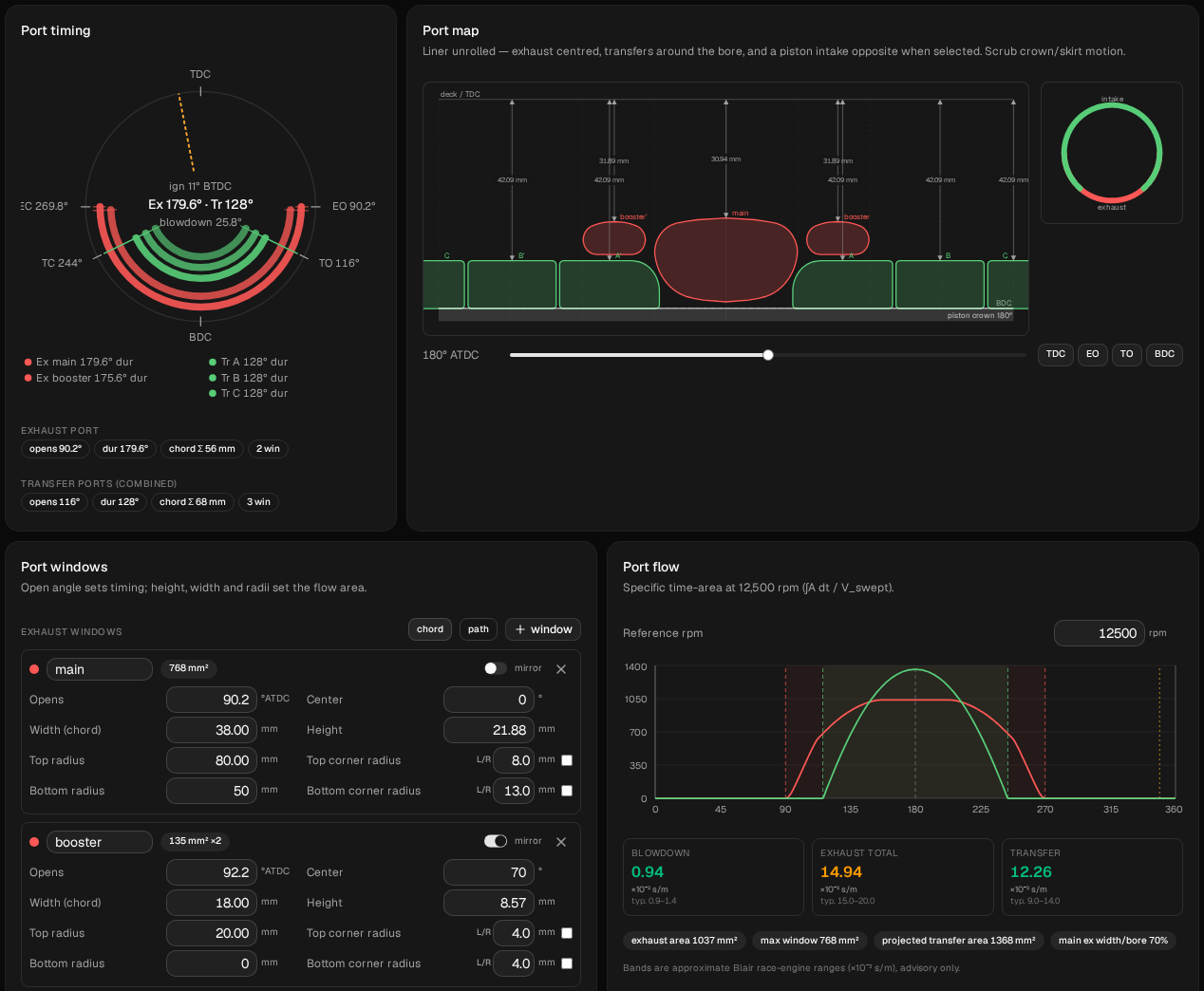
On Build → Ports, in the main window card, change Opens from 86 to 90.2. In the booster card, change it from 88 to 92.2. Type the values exactly and leave everything else alone, including Height: it follows by itself, because changing Opens moves the roof and keeps the floor where it is.
Check before you run:
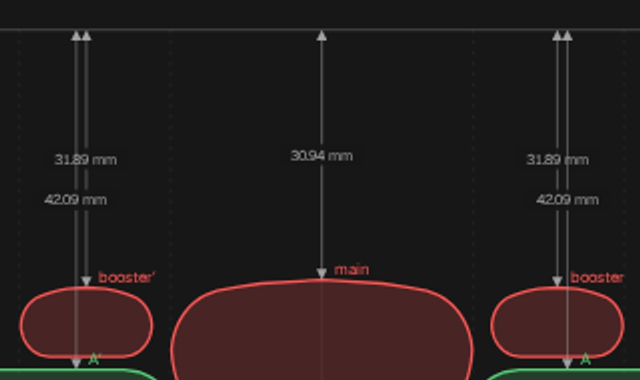
- Port map: 30.94 mm (main) and 31.89 mm (boosters) from the deck to the roof, 2.01 and 2.00 mm lower than before.
- Heights: 21.88 and 8.57 mm.
- Ring: Ex 179.6°, blowdown 25.8°.
- Build → Ducts: still 843 mm total, but tuned ≈ now reads 12600 rpm, down from 12900. The pipe hasn't changed. The badge reads the time from the exhaust opening to the transfers closing, and the exhaust now opens later (the calculator guide explains the rule).
Why 2 mm, and why it's illustrative. The 2 mm stands for what a closed valve does to the port: it opens later and the window is smaller. It isn't a measured blade position. A real valve's blade has its own shape, and how far it brings the roof down varies from engine to engine. Read the 2 mm as "a closed valve", not as anyone's valve.
The Port flow card has moved too. Blowdown is 0.94, still inside its typical band. Exhaust total is 14.94, just below its band of 15.0–20.0, and drawn in amber. The exhaust area chip reads 1037 mm², down from 1195. The card marks its bands as advisory only, and the app shows no warning for this edit. A closed valve is meant to make the port smaller, so the amber is what you'd expect.
Run the sweep and name it valve closed. Then check that only the port changed: Compare → Diff inputs against baseline should list five lines, all under Exhaust Port: the open angle of each window, the height of each window (in metres: the roof moving and the floor staying), and the exhaust port's own Open Angle, which follows the main. Nothing in the pipe and nothing in the ignition. The run description lists only the two angles you typed; use Diff inputs to check.
3. Closed against open
In Compare, set baseline as the baseline so the tooltip shows the difference.
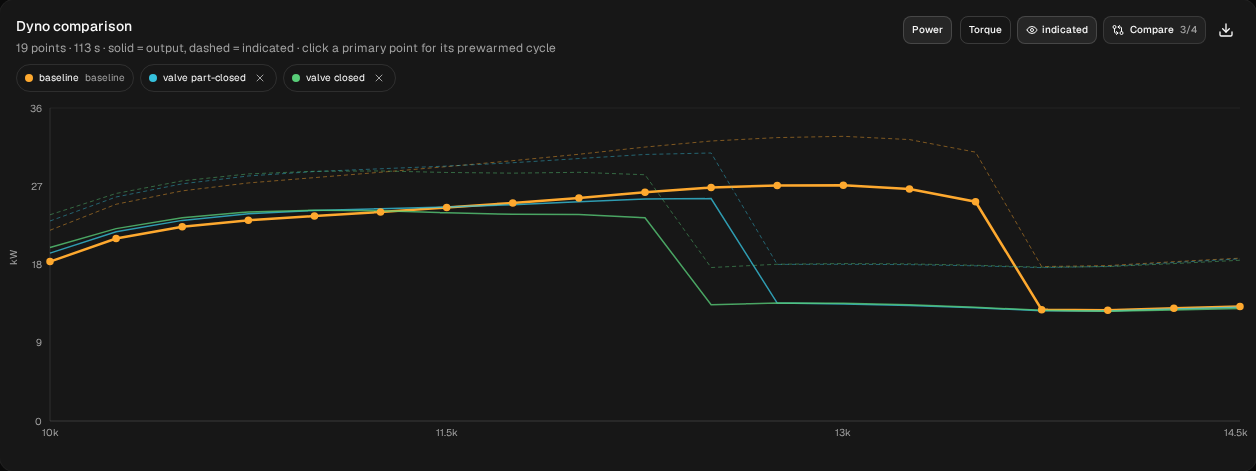
| rpm | open kW | closed kW | closed − open |
|---|---|---|---|
| 10,000 | 18.33 | 19.97 | +1.63 (+8.9 %) |
| 10,250 | 20.99 | 22.13 | +1.14 |
| 10,500 | 22.33 | 23.39 | +1.06 |
| 10,750 | 23.09 | 24.05 | +0.96 |
| 11,000 | 23.57 | 24.25 | +0.69 |
| 11,250 | 24.05 | 24.20 | +0.15 |
| 11,500 | 24.55 | 23.94 | −0.61 |
| 11,750 | 25.08 | 23.77 | −1.31 |
| 12,000 | 25.66 | 23.76 | −1.90 |
| 12,250 | 26.31 | 23.39 | −2.93 (−11.1 %) |
| 12,500–13,500 | on the pipe | off the pipe | – |
| 13,750–14,500 | off the pipe | off the pipe | – |
Italics: off the pipe. Every point of every run in this guide converged.
Read it in three parts.
Below 11,500 rpm, closed is ahead. At every point from 10,000 to 11,250, and the gap is largest at the bottom: 1.63 kW at 10,000, 0.69 at 11,000, 0.15 at 11,250.
From 11,500 up, closed is behind. 0.61 kW at 11,500, 1.90 at 12,000, 2.93 at 12,250. The curves cross somewhere between 11,250 and 11,500.
Then it falls off the pipe sooner. The closed run drops between 12,250 and 12,500 rpm; the open one between 13,500 and 13,750. From 12,500 to 13,500 one run is on the pipe and the other isn't, and from 13,750 up both are off. The table doesn't put a figure on those rows. Falling off the pipe is a step in this model, sharper than on a real dyno, and the size of the step says which state each run is in, not what the valve is worth (Raise the exhaust port, section 2).
The highest sampled points: 24.25 kW (32.5 hp) at 11,000 rpm closed, against 27.13 kW (36.4 hp) at 13,000 open. They're 2,000 rpm apart, and the open one is at an rpm where the closed run is already off the pipe, so don't subtract one from the other.
Why, in the model's terms. Switch the second chart under the power curve to DR. At 10,000 rpm the two runs deliver almost the same charge: DR 1.260 closed, 1.267 open. But the CSV's trapped mass, all the gas in the cylinder when the exhaust port closes, including what's left of the last cycle's burnt gas, is 114.18 mg closed against 106.82 mg open. Its trapped purity, the fresh share of that gas, is 0.956 against 0.963, so about 109.1 mg of it is fresh charge with the valve closed, against 102.9 mg open. With about the same charge delivered, the closed port ends up with more fresh charge in the cylinder. That fits a port that closes earlier and holds on to more of what came in, but these figures don't single it out as the cause of the gain. At 12,250 it's the other way: less comes in (DR 1.292 against 1.332) and less gas is in the cylinder at exhaust closing (111.17 mg against 125.60, about 107.2 mg of it fresh against 120.7). This is one model's answer, not a check on the YPVS paper.
The closed valve also runs cooler near the top: 528 °C against 588 °C at 12,250 (switch the chart to EGT). At 10,000 the two are within 4 °C.
4. A valve that doesn't close all the way
A valve that stops short of closed leaves the roof somewhere in between. Model 1 mm. Restore baseline first (Compare → restore icon → Restore settings; the run selector at the top keeps the last run's name after a restore, which is expected), check the windows read 86 and 88 again, then set Opens to 88.1 (main) and 90.1 (booster).
Check: Port map 29.94 and 30.90 mm, heights 22.89 and 9.57, ring Ex 183.8°, tuned ≈ 12700 rpm, Port flow Blowdown 1.13 and Exhaust total 16.41, both green. Run it and name it valve part-closed. Diff inputs against baseline again lists five Exhaust Port lines.
| rpm | open kW | part-closed kW | part − open | closed − open |
|---|---|---|---|---|
| 10,000 | 18.33 | 19.31 | +0.98 (+5.3 %) | +1.63 |
| 10,500 | 22.33 | 23.07 | +0.75 | +1.06 |
| 11,000 | 23.57 | 24.21 | +0.65 | +0.69 |
| 11,250 | 24.05 | 24.42 | +0.38 | +0.15 |
| 11,500 | 24.55 | 24.61 | +0.06 | −0.61 |
| 11,750 | 25.08 | 24.87 | −0.21 | −1.31 |
| 12,000 | 25.66 | 25.21 | −0.45 | −1.90 |
| 12,250 | 26.31 | 25.54 | −0.78 | −2.93 |
| 12,500 | 26.85 | 25.58 | −1.27 (−4.7 %) | off the pipe |
| 12,750–13,500 | on the pipe | off the pipe | – | – |
The rows not shown (10,250 and 10,750) are in the same direction; every figure is in the run's CSV.
Halfway in the roof gave a bit over half the gain at the bottom (0.98 kW at 10,000 against 1.63) and much less than half the loss at the top (0.78 kW at 12,250 against 2.93). It crosses below the open run between 11,500 and 11,750, and falls off the pipe between 12,500 and 12,750. Its highest sampled point is 25.58 kW (34.3 hp) at 12,500, its last point on the pipe.
5. Is the closed run's drop the valve, or the sweep?
Each sweep here works upwards, and each point starts from the state the one before it left behind. So valve closed reaches 12,250 already running on the pipe from 12,000. Pipe temperature (section 3) shows that where this engine falls off the pipe can depend on that: the template started cold at 13,000 or 13,500 is off the pipe, where its upward sweep is on it. At 13,750 it's off the pipe either way.
To see whether the closed valve can get onto the pipe at 12,250 on its own, start a sweep there. Restore valve closed, go to Run → Setup and set From to 12250, leaving To at 14500 and the step at 250. Diff inputs against valve closed should list one line, Sweep / Rpm Min, 10000 → 12250. Run it and name it valve closed cold 12250.
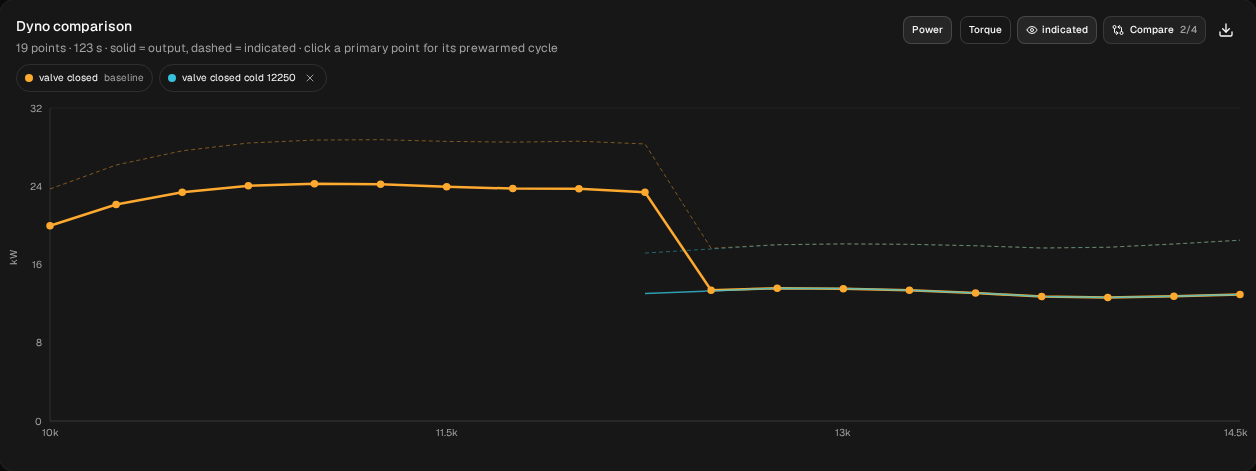
Started cold at 12,250, the closed valve is off the pipe: 13.05 kW, where the sweep from 10,000 has 23.39. From 12,500 up the two runs agree to within 0.06 kW at every point. So with the valve closed, 12,250 is on the pipe only when the engine arrives there from below.
That could be the valve, or it could be any cold start at 12,250 on this engine. To tell them apart, start the open valve there too. Restore baseline, set From to 12250 the same way (Diff inputs against baseline: one line, Sweep / Rpm Min), run it and name it valve open cold 12250. In Compare, set valve closed cold 12250 as the baseline.
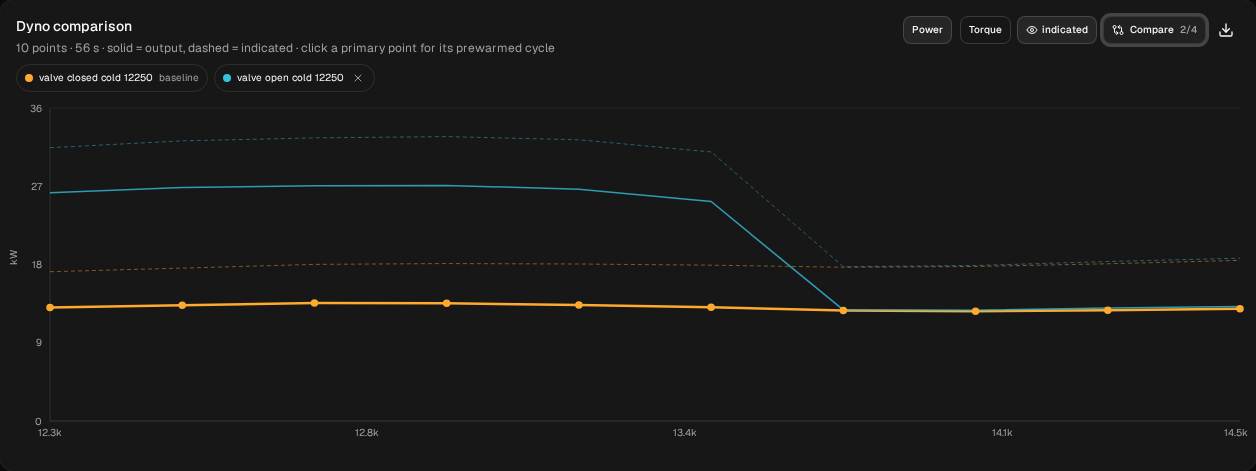
With the valve open, the same cold start at 12,250 is on the pipe: 26.25 kW, where the closed valve's cold start makes 13.05. From there the open run follows its sweep from 10,000 to within 0.07 kW at every point, and it falls off between 13,500 and 13,750 as that one does. So at 12,250 the two ends differ even from a cold start: the closed port can't get onto the pipe there on its own, and the open one can. The top end the closed valve gave up in section 3 isn't only a matter of how the sweep arrived. (The chart's rpm axis labels are rounded: the first, 12.3k, is 12,250.)
What these short runs don't show: whether the points above 12,250 would be on the pipe started cold. Only each sweep's first point starts cold; every point after it starts from the one below. So the open run's drop between 13,500 and 13,750 is a rising sweep's drop, like the others on this page.
6. What a stuck valve costs, at the model's two ends
A working valve moves between these ends as the rpm changes. These sweeps hold it fixed for the whole run, which is what a valve stuck in one place does. So, in this model, on this engine:
- Stuck open (the port at full height all the time): from 10,000 to 11,250 rpm the engine gives up what the closed port would have made, 1.63 kW (8.9 %) at 10,000, falling to 0.15 kW at 11,250. From 11,500 up, open is the better end, so it costs nothing there.
- Stuck closed (the roof 2 mm down all the time): below 11,500 it's the better end. From 11,500 up it gives up 0.61 to 2.93 kW (11.1 % at 12,250), and it falls off the pipe between 12,250 and 12,500 rpm instead of between 13,500 and 13,750. Section 5 shows that, started cold at 12,250, it isn't on the pipe at all.
- Stuck 1 mm short of closed: a smaller version of both. It's 0.98 kW (5.3 %) up at 10,000, ahead to 11,500, then behind by up to 1.27 kW (4.7 %) at 12,500, and off the pipe between 12,500 and 12,750.
The crossover is the useful number. In this model, on this engine, the closed port is the better of the two ends below about 11,250–11,500 rpm and the open port above it. Where a real engine's valve starts to open is set by its maker's design, and this page doesn't say what yours should do.
| Run | Ex duration | tuned ≈ | Highest sampled point | Falls off the pipe between |
|---|---|---|---|---|
baseline (open) | 188° | 12,900 | 27.13 kW (36.4 hp) at 13,000 | 13,500 and 13,750 |
valve part-closed (1 mm) | 183.8° | 12,700 | 25.58 kW (34.3 hp) at 12,500 | 12,500 and 12,750 |
valve closed (2 mm) | 179.6° | 12,600 | 24.25 kW (32.5 hp) at 11,000 | 12,250 and 12,500 |
What to take from it
On this model, with this pipe:
- Closing the valve (the roof 2 mm lower) traded the top for the bottom. It was up to 1.63 kW ahead from 10,000 to 11,250 rpm and up to 2.93 kW behind from 11,500 to 12,250, and it fell off the pipe between 12,250 and 12,500, where the open port held on to 13,500.
- At the bottom, the closed port ended with more gas in the cylinder from about the same delivery: almost the same DR at 10,000, but 7.36 mg more total trapped gas, about 6.2 mg more of it fresh charge.
- A valve 1 mm short of closed kept a bit over half the bottom-end gain and gave up much less than half the top.
- Started cold at 12,250, the open port was on the pipe and the closed one wasn't, so the closed valve's early drop isn't only a matter of how the sweep got there.
- Above about 11,500 rpm, the open port is the better end; below about 11,250, the closed one is. A valve stuck at either end gives up the other end's share.
Those are answers for one engine that you can check, not rules. To get them for yours:
- Enter your own engine and port. Then lower the roofs by what your valve's blade covers. Set each window's Opens until the Port map shows the depth you want; the degrees in this guide only hold for this engine.
- Change one thing at a time, restore the baseline before each change, and check with Diff inputs, not the run description.
- Check the edge with a cold start before you read anything into where a run falls off.
If you have dyno sheets from the same engine with the valve working and with it fixed open or closed, join the tester programme. That comparison is what we most want to see.
These are simulated estimates from a 1D gas-dynamics model of a generic engine, not measurements, and not your engine. The model isn't calibrated against a dyno. Even the differences between the runs hold only for this model. The template has no power valve: these runs change only the exhaust roof's height, and model nothing of the blade itself, its leakage, or any chamber a valve opens. The model shows falling off the pipe as a sharp step, sharper than a real dyno, and where the step lands can depend on the direction of the sweep. Use WaveDyno to compare designs and to understand what the port and the pipe are doing. See the Terms of Service, section 4.