2-stroke pipe temperature: does a hotter expansion chamber hit at higher rpm?
Tutorial 10 · about 10 minutes plus four sweeps and two short ones
A pressure wave travels faster in hotter gas, so a hotter pipe sends its waves back to the port sooner. The same pipe should then work at a higher rpm. It's behind the question of why a bike pulls differently on a dyno with no fan than on the track, and it's the rule in tutorial 5: the waves' travel time depends on the pipe's lengths and the gas temperature.
WaveDyno models the pipe wall, and you can take the cooling air away. This guide does that on the app's 125 cc moto-X engine and reads what moves: the exhaust-gas temperature, the bottom of the band and the top of it. Then it gives the pipe more air, and then a polished surface.
The short answer, in this model: taking the air away makes the exhaust gas up to tens of degrees hotter and costs power at the bottom of the sweep. Swept upwards, the engine also stays on the pipe one 250 rpm step longer. Started cold at 13,000, 13,500 or 13,750, it's off the pipe, like the default pipe, so that extra step isn't confirmed. Section 3 compares the two kinds of start.
What the page can't answer:
- How hot a real pipe gets. The app computes a wall temperature, but no screen and no export shows it. What you can read is the exhaust-gas temperature at the model's probe. So this page says how the cooling changes that, and changes the power, in the model. It doesn't say what temperature a real chamber runs at, or should.
- Your engine and your pipe. The example is the app's 125 moto-X archetype, the engine of tutorials 1, 2, 4, 5 and 9. It isn't a YZ125, a KTM 125 or anyone's actual engine, and the model isn't calibrated against a dyno.
- Whether to wrap, coat or cool a pipe. The page changes two settings of a model and reports what the model does. It doesn't tell you what to do to a real pipe, or what a bike will do on the track.
Everything here runs on WaveDyno's free plan with daily run limits. Each full sweep has 19 points; the Run dyno button showed 16.6 units for each one here. A finished sweep is charged what it actually used, up to its estimate. Depending on what you've already run today and what each sweep is charged, you may not get through them all in one UTC day. The app refuses a run whose estimate doesn't fit in what's left of the day, and the limit resets at midnight UTC. Your runs stay in the project, so you can pick up where you stopped.
The engine
Create a new project with the setup wizard (the + button, as in tutorial 1), pick 125 moto-X / enduro, keep every answer at its default and create it. Then on Run → Setup, set the sweep to 10,000 to 14,500 rpm in 250 rpm steps, quality Standard. That's the sweep of tutorials 4 and 9.
Run it and name it baseline. It's the same run as tutorial 9's baseline:
- Best point 27.129 kW (36.4 hp) at 13,000 rpm. The top is flat: 12,750 is only 0.042 kW lower.
- On the pipe all the way to 13,500, still 25.219 kW there.
- Off the pipe by 13,750: 12.795 kW, less than half. A 250 rpm sweep puts the drop somewhere between 13,500 and 13,750, no closer.
On the Ducts tab the badge reads tuned ≈ 12900 rpm. That badge works out the timing from the pipe's lengths at one fixed wave speed, so it can't know the pipe's temperature: it reads 12900 through every run on this page. Whatever moves here, the sweep shows it and the badge doesn't. Tutorial 2 explains why the badge and the sweep needn't agree.
1. Find the pipe-wall model
Go to Build → Ducts. In the Exhaust pipe card, open Model calibration (advanced). It's the section with the mesh, the EGT probe, the end correction and the wall model. Opening it on one tab opens it on all of them. The group Pipe wall model has six fields; this page uses two of them:
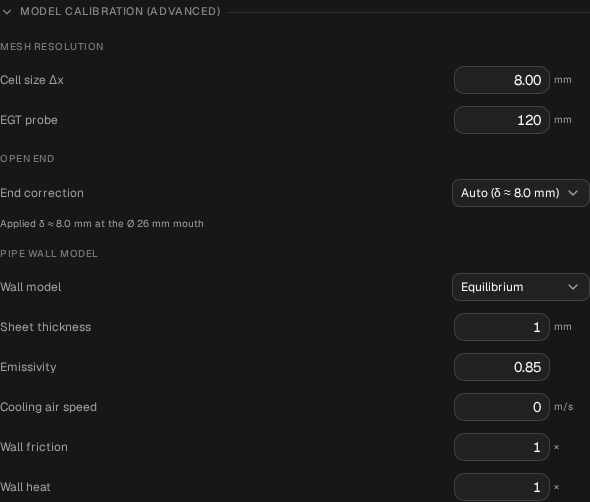
- Wall model: Equilibrium. Along the pipe, the model sets each part of the wall at the temperature where the heat coming in from the gas equals the heat going out to the air. A hotter wall takes less heat out of the gas, so the gas stays hotter.
- Cooling air speed: 13.9 m/s by default, which is 50 km/h: the airflow over a moving bike, or a dyno fan. The model works out the outside cooling from that speed and the pipe's local diameter. Hover the field for its note: “0 = a static bench with no fan (hotter pipe)”.
- Emissivity: 0.85 by default. It's how strongly the outside of the pipe radiates heat away. The field's note gives about 0.85 for painted black or rusty steel and about 0.2 for polished or plated.
- Sheet thickness 1 mm, Wall friction and Wall heat: leave them as they are.
One thing about 0 m/s in this model: it means no air cooling at all. The model doesn't add the slow natural convection that still air gives a hot pipe, so at 0 the pipe loses heat by radiation alone. That's a limit of the model: read the next section as the model's extreme case, not as a dyno without a fan.
Higher up in the same section, EGT probe reads 120 mm: the model samples the exhaust-gas temperature 120 mm down the header. Every EGT on this page is at that probe. It's the gas temperature, not the wall's. The Cycle analysis tab's EGT tile uses the same probe; its subtitle reads “mass-weighted, 120 mm down the header”.
2. Take the cooling air away
Set Cooling air speed to 0. Nothing else changes: the Ducts table and the badges still read 843 mm total and tuned ≈ 12900 rpm. Compare → Diff inputs against baseline should list one line, Exhaust / Wall Thermal / Air Speed, 13.9 → 0 (tutorial 2 shows where Diff inputs is). Run the sweep, name it air 0, and in Compare set baseline as the baseline. Switch the lower chart to EGT.
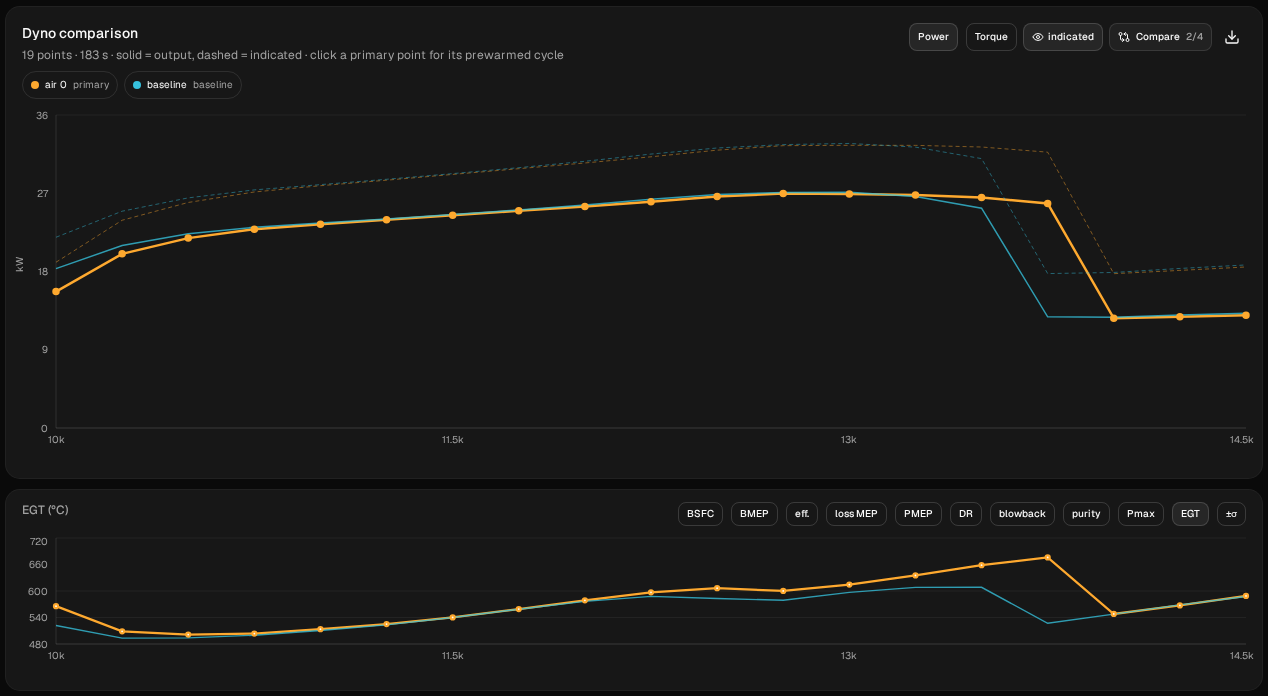
| rpm | baseline kW | air 0 kW | change kW | baseline EGT °C | air 0 EGT °C | change °C |
|---|---|---|---|---|---|---|
| 10,000 | 18.331 | 15.688 | −2.643 | 522.1 | 565.7 | +43.6 |
| 10,250 | 20.989 | 20.036 | −0.954 | 493.5 | 508.6 | +15.1 |
| 10,500 | 22.329 | 21.840 | −0.489 | 493.8 | 501.4 | +7.6 |
| 10,750 | 23.088 | 22.868 | −0.219 | 500.0 | 503.8 | +3.9 |
| 11,000 | 23.565 | 23.444 | −0.122 | 510.8 | 513.8 | +3.1 |
| 11,250 | 24.045 | 23.947 | −0.098 | 523.2 | 525.0 | +1.9 |
| 11,500 | 24.550 | 24.463 | −0.088 | 540.1 | 540.2 | +0.0 |
| 11,750 | 25.083 | 24.972 | −0.112 | 558.6 | 559.0 | +0.4 |
| 12,000 | 25.658 | 25.476 | −0.182 | 576.4 | 578.7 | +2.3 |
| 12,250 | 26.314 | 26.031 | −0.283 | 587.8 | 596.6 | +8.8 |
| 12,500 | 26.845 | 26.609 | −0.236 | 583.8 | 606.1 | +22.3 |
| 12,750 | 27.086 | 26.972 | −0.115 | 579.3 | 600.2 | +20.9 |
| 13,000 | 27.129 | 26.921 | −0.208 | 596.8 | 614.9 | +18.1 |
| 13,250 | 26.678 | 26.812 | +0.133 | 610.3 | 634.9 | +24.6 |
| 13,500 | 25.219 | 26.505 | +1.287 | 606.3 | 658.6 | +52.3 |
| 13,750 | 12.795 | 25.888 | +13.093 | 526.9 | 677.5 | +150.7 |
| 14,000 | 12.732 | 12.597 | −0.135 | 547.7 | 548.0 | +0.3 |
| 14,250 | 12.972 | 12.790 | −0.182 | 568.7 | 567.3 | −1.4 |
| 14,500 | 13.164 | 12.987 | −0.177 | 588.0 | 588.3 | +0.3 |
Italics: off the pipe. Every point converged in both runs.
Read it from the bottom up.
The bottom of the sweep loses. At 10,000 the pipe with no air makes 2.643 kW less (−14.4 %), and the loss shrinks point by point to −0.219 kW at 10,750. The exhaust gas is 43.6 °C hotter at 10,000.
The middle hardly moves. From 11,000 to 12,000 the two runs are within 0.182 kW of each other, and the EGT within 3 °C.
The top runs hotter, for about the same power. From 12,250 to 13,500 the exhaust gas is 8.8 to 52.3 °C hotter at the probe, and the power is 0.115 to 0.283 kW lower, until 13,250, where it's 0.133 kW higher, and 13,500, where it's 1.287 kW higher as the baseline starts to fall away. The best point moves from 13,000 to 12,750, but on a top this flat that means little: air 0's 12,750 and 13,000 are 0.051 kW apart. Its best point, 26.972 kW (36.2 hp), is 0.157 kW below the baseline's.
And at 13,750 it's still on the pipe. 25.888 kW where the baseline has fallen to 12.795, then off the pipe by 14,000. That's one 250 rpm step more, and it's what Diff inputs and the badge can't show you.
The direction fits the wave-speed rule: hotter gas, waves back sooner, so the pipe gives up a little at the bottom and holds on a little at the top. The size is small. From 11,000 up, apart from 13,500 and 13,750, no point moves by more than 0.283 kW. The next section checks the extra step from a cold start, comparing like with like.
3. Compare cold start with cold start
In the sweeps on this page, the app works upwards, and each point starts from the state the one before it left behind: the gas in the pipe, and the wall temperatures. Only the first point starts cold. So in air 0, the engine reaches 13,750 already running on the pipe from 13,500, and in baseline it reaches 13,500 on the pipe from 13,250. To compare the two from a cold start, start both sweeps higher up, at the same rpm.
With baseline loaded (Compare → its restore icon → Restore settings), go to Run → Setup and set From to 13000, leaving To at 14500 and the step at 250. Diff inputs against baseline should list one line, Sweep / Rpm Min, 10000 → 13000. The button shows 5.4 units: seven points. Run it and name it baseline cold 13000. Then do the same from air 0 and name it air 0 cold 13000. In Compare, set baseline cold 13000 as the baseline.
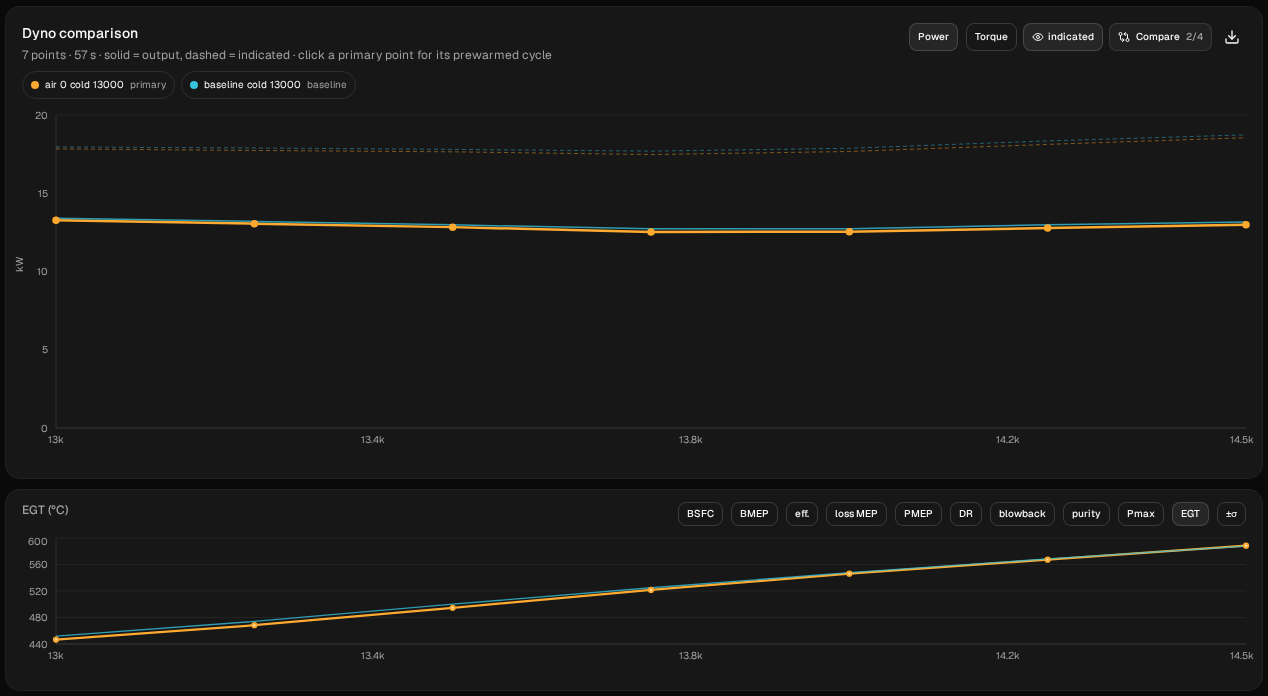
| rpm | baseline from 10,000 | baseline from 13,000 | air 0 from 10,000 | air 0 from 13,000 |
|---|---|---|---|---|
| 13,000 | 27.129 kW | 13.410 kW | 26.921 kW | 13.295 kW |
| 13,250 | 26.678 | 13.198 | 26.812 | 13.060 |
| 13,500 | 25.219 | 12.978 | 26.505 | 12.834 |
| 13,750 | 12.795 | 12.715 | 25.888 | 12.548 |
| 14,000 | 12.732 | 12.743 | 12.597 | 12.533 |
| 14,250 | 12.972 | 12.950 | 12.790 | 12.788 |
| 14,500 | 13.164 | 13.169 | 12.987 | 12.996 |
Italics: off the pipe. Every point converged. In the two “from 13,000” columns only the first row is a cold start; each row after it starts from the row before, the next lower rpm.
Started cold at 13,000, both are off the pipe: 13.410 kW for the baseline, 13.295 for air 0. Hover 13,000 and the tooltip reads −0.11 kW, −0.9 %. Compared like with like at 13,000, no cooling air doesn't keep the engine on the pipe where the default pipe isn't.
Each run then keeps the way it started. baseline from 13,000 stays off the pipe all the way up, at 12.715 to 13.410 kW, where the sweep from 10,000 was on the pipe up to 13,500. air 0 from 13,000 stays off the pipe too, at 12.533 to 13.295 kW, where its sweep from 10,000 was on the pipe up to 13,750.
We also started both runs cold nearer the drop: from 13,500 and from 13,750, the same way, with To 14500 and step 250. Neither comes up on the pipe. Started there, air 0 makes 12.90 kW at 13,500 and 12.59 at 13,750, where its sweep from 10,000 has 26.505 and 25.888. The baseline makes 13.04 kW at 13,500, where its sweep from 10,000 has 25.219, and 12.75 at 13,750, where both are off the pipe. Every point of these four sweeps is off the pipe, at 12.53 to 13.18 kW, and every point converged.
So in this model, taking the cooling air away moved the drop up by one 250 rpm step in the rising sweeps, but no cold start confirms that step: started cold at 13,000, 13,500 or 13,750, both runs are off the pipe. These sweeps return different converged results depending on the start: on the pipe when swept up from 10,000, off it when started cold, for the baseline from 13,000 to 13,500 and for air 0 from 13,000 to 13,750. Feedback between charge, temperature and returning waves is a possible explanation; these runs do not isolate it.
What these runs don't show: where either run falls off the pipe from a cold start. The only cold starts here are at 13,000, 13,500 and 13,750, each the first point of a sweep in 250 rpm steps. Both runs are off the pipe from each of them; these runs do not locate a cold-start transition. Nor do they show where between 13,750 and 14,000 the rising air 0 sweep drops. More air and a polished pipe weren't started cold at all.
The check itself applies to any sweep with a sudden drop. If a change seems to move the drop, compare like with like before you believe it: for each run you compare, start a short sweep at the same rpm near the drop.
4. More air, and a polished pipe
The other two settings, one at a time, each from baseline (restore it first, and check that Diff inputs against baseline is empty, then make the one change):
- Cooling air speed 27.8 m/s (100 km/h), named
air 27.8. Diff inputs:Air Speed13.9 → 27.8. - Emissivity 0.2 (a polished or plated pipe), cooling air back at 13.9, named
emissivity 0.2. Diff inputs:Emissivity0.85 → 0.2.
If you ran section 3's short sweeps first, restoring baseline also puts the sweep back to 10,000; check that Setup reads From 10000.
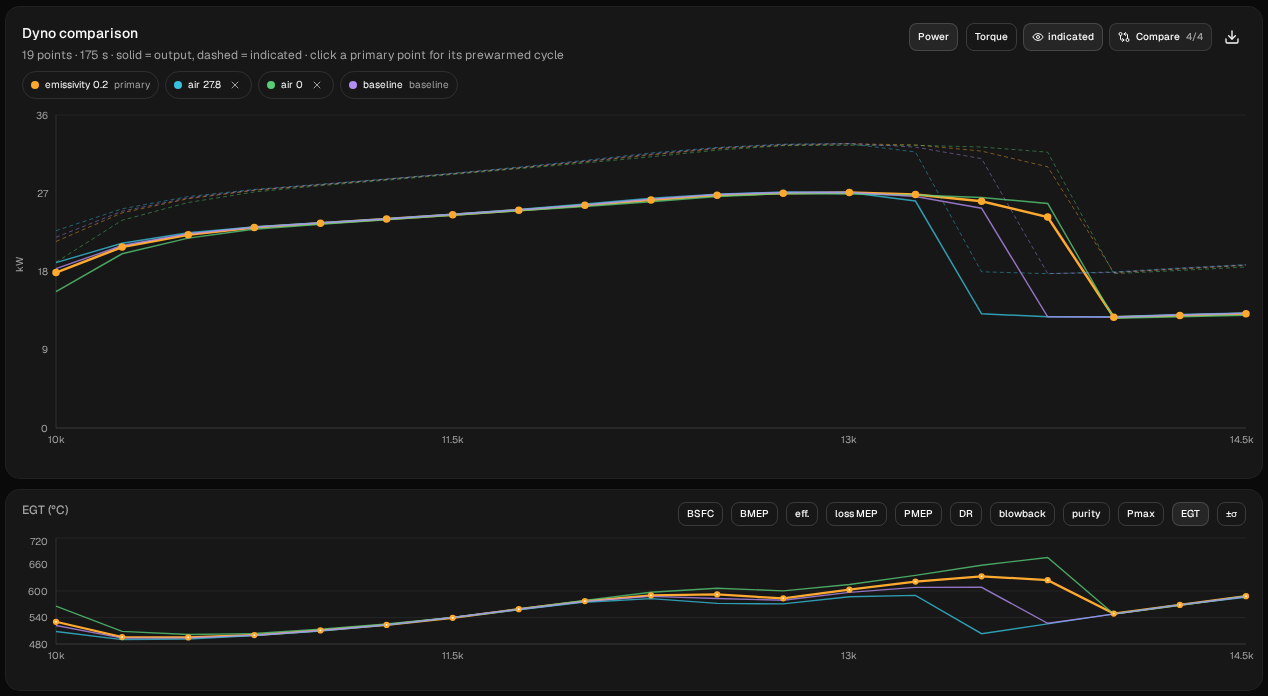
| Run | Best point | Last point on the pipe | 10,000 rpm | 13,750 rpm | EGT at 13,750 |
|---|---|---|---|---|---|
| baseline (13.9 m/s, 0.85) | 27.129 kW at 13,000 | 13,500 | 18.331 kW | 12.795 kW | 526.9 °C |
air 0 | 26.972 kW at 12,750 | 13,750 (swept up) | 15.688 (−2.643) | 25.888 (+13.093) | 677.5 (+150.7) |
| air 27.8 | 27.136 kW at 12,750 | 13,250 | 19.025 (+0.694) | 12.773 (−0.022) | 525.7 (−1.2) |
emissivity 0.2 | 27.067 kW at 13,000 | 13,750 | 17.872 (−0.459) | 24.292 (+11.498) | 627.2 (+100.3) |
Twice the air is the mirror image of no air. At 100 km/h the pipe gains at the bottom (+0.694 kW, +3.8 %, at 10,000), and its exhaust gas is cooler at every point up to 13,250, by up to 20.3 °C. It falls off the pipe one step before the baseline, between 13,250 and 13,500: at 13,500 it makes 13.142 kW against the baseline's 25.219. Its best point, 27.136 kW (36.4 hp), is 0.007 kW above the baseline's, on an equally flat top.
A polished pipe is a small step towards no air. With emissivity 0.2 the pipe radiates less heat, so its exhaust gas runs up to 28.5 °C hotter where both are on the pipe. The power stays within 0.168 kW of the baseline from 10,750 to 13,250; it's −0.459 kW at 10,000, −0.167 at 10,250 and +0.893 at 13,500, and like no air it falls off the pipe one step after the baseline, between 13,750 and 14,000.
The gap between no air and the default is much bigger than between the default and twice the air. Going from 13.9 m/s to 0 takes all of the convection away; going to 27.8 adds only part of it again.
What to take from it
- In this model, the cooling air changes the exhaust-gas temperature by tens of degrees. At the 120 mm probe, from 10,000 to 13,250 rpm, where every run is on the pipe, no air ran up to 43.6 °C hotter, 100 km/h of air up to 20.3 °C cooler, and a polished pipe up to 10.2 °C hotter. At 13,750 no air was 150.7 °C hotter than the baseline, but there one is on the pipe and the other isn't, so that gap compares two different ways of running, not two coolings. When EGT readings from two runs disagree, look at the cooling first.
- It changes power at the bottom of the sweep more than at the top. No air cost 2.643 kW at 10,000, and no more than 0.283 kW anywhere from 11,000 to 13,250. The direction is what the wave-speed rule predicts; the size is under a sweep step.
- No air moved the drop up in the rising sweeps, and no cold start confirmed it. Swept up from 10,000, no air stayed on the pipe one 250 rpm step longer than the default. Started cold at 13,000, 13,500 or 13,750, both were off the pipe, so up to each run's drop the two kinds of start returned different converged results. These runs don't show where either drops from a cold start, and more air and a polished pipe weren't started cold; in their rising sweeps more air dropped one step before the baseline, between 13,250 and 13,500, and a polished pipe one step after it, between 13,750 and 14,000.
- The tuned ≈ badge doesn't know about temperature. It read 12900 through every run. If you're asking what the pipe's temperature does, sweep.
- 0 m/s is the model's extreme. It takes away all outside convection, natural convection too, and leaves radiation only. That's a limit of the model. What a real pipe does on a dyno without a fan is for a real dyno.
Next: tutorial 5 shows the waves themselves in the wave diagram, and why the band ends where it does. Tutorial 9 moves the band with the pipe's lengths instead: on this engine, a pipe designed 900 rpm lower moved the highest sampled point down 1,500 rpm, much further than any temperature here.